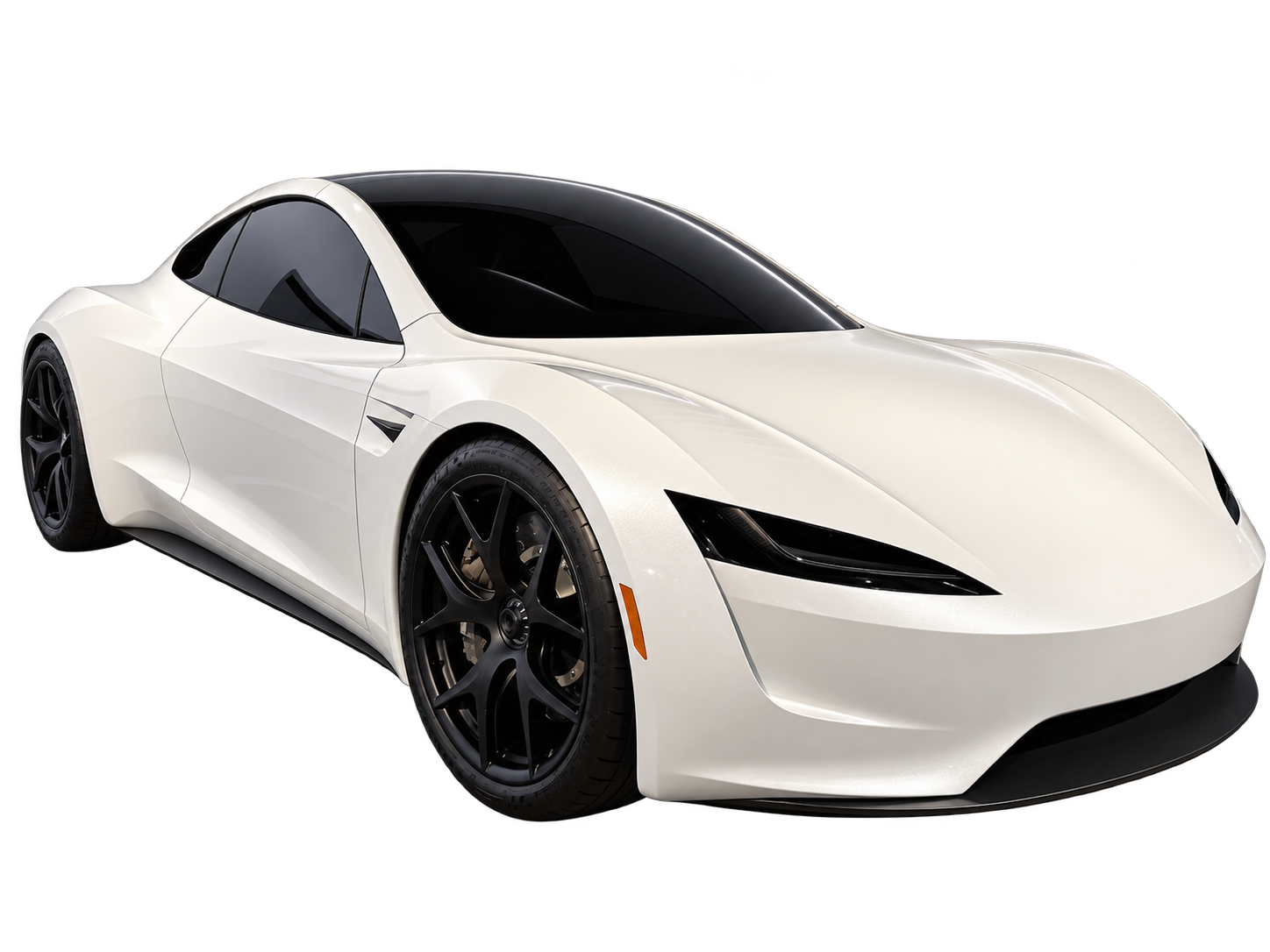
A black flying car can look convincing in a still and disappear as soon as it moves. The roof merges with the skyline, the wheels vanish into the road and the first lift becomes impossible to read. The answer is usually a clearer relationship between the car, its reflections and the background, rather than a brighter overall scene.
Start by deciding what the viewer needs to see: the shape of the car, the moment its tyres leave the surface, or the changing distance between the vehicle and its shadow. A night scene can preserve all three, but asking for darkness everywhere gives the picture very little room to explain them.
A glossy black surface shows its surroundings
In broncolor's car-photography tutorial, photographer Philipp Rupprecht explains the importance of large light sources and of controlling the surroundings that appear in reflective bodywork. The useful principle is that the environment helps describe the car's shape. Read the automotive lighting tutorial.
For an AI scene, translate that principle into visible conditions: a broad area of pale sky reflected along the shoulder, a bright wall beside the car, or a long overhead light echoed in the roof. These are scene-design choices. Describing a physical studio light does not give the generator a calibrated lighting rig.
Keep a distinction between the paint and the highlight. A pale reflection along one curved surface can coexist with black paint elsewhere. If every panel becomes uniformly silver, the image has lost that distinction. Asking for more contrast without identifying the intended reflection may just make the wheels darker.
Choose the background before choosing the effect
A dark car against a pale overcast sky is easier to read than the same car against a dark tree line. A clean concrete wall can establish the side profile without adding a second colour to the paint. A busy street full of tiny highlights asks the viewer to separate body reflections from background lights throughout the shot.
For a first lighting study, choose one useful contrast: a black coupe beside light stone, for instance, with an uninterrupted strip of road beneath it. Keep the car's route within that contrast. A clear opening against a bright wall does not help if the takeoff happens in front of a black tunnel entrance.
Night scenes need a similar plan. A rim of light around the roof may preserve the silhouette, but it cannot explain a dark wheel against dark asphalt. Give the lower body a separate visual reference, such as a lighter road surface or a reflection that reaches the wheel arch. Do not rely on headlights alone to describe the whole vehicle.
Let the finish change how the shot is built
Gloss black and matte black should not be interchangeable words in the brief. A glossy finish invites readable reflections. A matte treatment asks the outline and broader changes of light to do more of the work. Combining an insistence on matte paint with mirror-like reflections can leave the intended surface ambiguous.
If you have a reference photograph, inspect whether the black bodywork is actually visible in it. A silhouette taken at sunset might communicate the roof outline while hiding every side panel. A photograph full of reflected trees may carry those patterns into a scene where they no longer belong.
Use a clearer authorized image when appearance matters. Our text versus reference-photo guide covers the input trade-off. One optional image can guide the subject; it is not a promise that every reflection will be physically reconstructed as the camera moves.
Plan the lift around the ground plane
A takeoff becomes readable when there is a visible gap under the tyres. Keep enough road in frame for that gap to develop. If the body is black, the space below it must not collapse into a single dark patch that includes the wheels, shadow and background.
A restrained side or three-quarter view can show the separation without requiring a large camera move. Choose one direction of travel. A rotating car, orbiting camera and moving spotlight create three sources of change, so a lighting failure becomes harder to diagnose.
Think about the reflection during the lift too. A long reflected window should move across the body as the viewpoint or orientation changes. If the painted surface appears to contain a fixed picture of the opening scene, the reflection may read as a decal. That is a reason to simplify the surroundings or reduce the turn, rather than adding more effects.
Diagnose the failed picture before rewriting everything
- The car disappears: change the background behind the critical movement, or add a readable edge of light. Keep the paint description unchanged for that revision.
- The paint turns grey: separate the intended highlight from the unlit body. Avoid asking for bright illumination on every visible surface.
- The wheels disappear: check the lower-body background and the road. A clearer roof highlight will not fix this part of the frame.
- The finish changes during a turn: reduce the angle change or use a less complicated reflected environment.
Review at normal phone size and with the clip paused. At 480p, tiny badges and subtle surface textures should not carry the whole identity of the car. A stable silhouette and a clearly visible lift matter more than a close crop of an indistinct emblem.
Finish with a frame that still explains the car
Give the final position enough time to be understood. If the car ends against a different background, check that the black finish still reads correctly there. A strong first frame is only one lighting condition; the endpoint can fail for an entirely different reason.
You can describe your own black flying car in the creator with text alone or one optional image. Choose the light, background and action in your own words. There is no preset to select, and the scene does not need to imitate a real vehicle demonstration.
These are editorial planning recommendations, not results from a controlled model test. AI output varies; a description or reference photo cannot guarantee a specific result. Flying Car AI is independent and is not affiliated with, endorsed by or sponsored by Tesla, Inc. or any vehicle manufacturer.