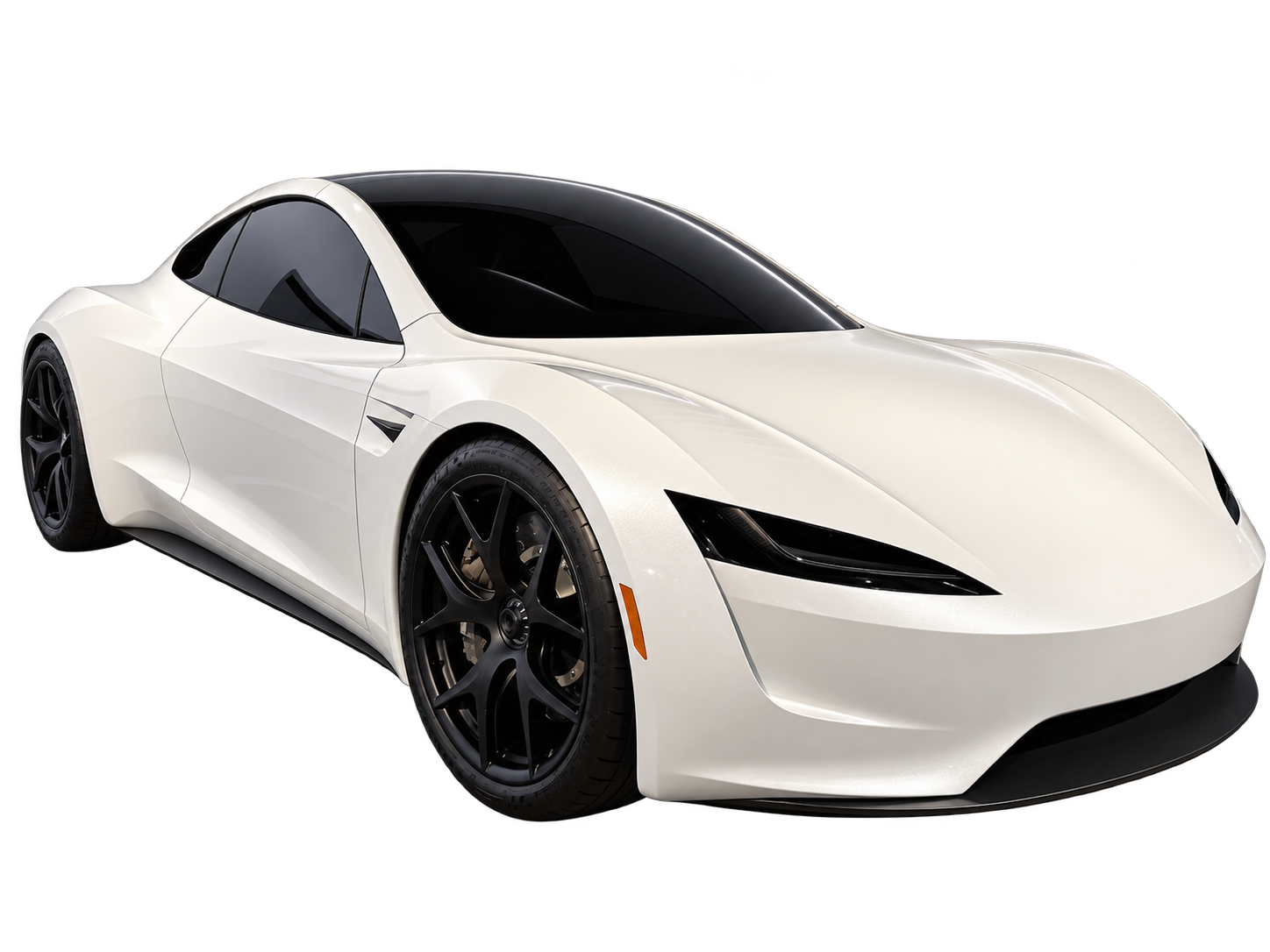
The short answer: the Roadster's airborne movement is associated with gas thrusters, while its surface-holding system has a different job. Treating both as “the flying system” makes the demonstration harder to understand. The direction of the force is the useful distinction.
Surface grip and lift are opposite tasks
Tesla describes a fan and ground-sealing arrangement that lowers pressure beneath the vehicle, and separately describes cold-gas hardware for movement and stabilization. Those are manufacturer descriptions, not measurements we have independently verified. See the current Roadster material.
For the pressure system, imagine two sides of the vehicle experiencing different air pressure. The resulting force acts toward the lower-pressure region. The relevant surface and the car's orientation matter: describing a vehicle as “stuck to a ceiling” is different from describing it as hovering freely below that ceiling.
That distinction answers a common viewing mistake. A car held against a prepared surface has a surface interaction supporting the manoeuvre. Once the car leaves it, the explanation must account for what supports or changes its airborne motion. The first observation does not explain the second by itself.
Gas leaving a nozzle produces a reaction force
NASA's explanation of thrust describes gas being accelerated in one direction and the vehicle receiving force in the opposite direction. Direction matters as much as magnitude: rearward flow can push forward; downward flow can contribute upward force. A force applied away from the centre of mass can also change orientation. Read NASA's thrust explanation.
Do not confuse the visible gas with the force itself. A plume in a picture is not a measurement of mass flow, pressure or total impulse. Its apparent size can change with illumination, camera exposure and atmospheric conditions. A dramatic white cloud does not tell a viewer how long the system could support a particular motion.
The word “cold” distinguishes a gas-thruster approach from combustion-driven propulsion; it does not mean a video must show ice or blue flames. NASA's propulsion overview discusses cold-gas systems and related approaches. It explains a general technology, not a certification or assessment of this car. See NASA's propulsion overview.
A hop, a hover and a journey need different evidence
A hop establishes an airborne interval. A hover asks for position to be maintained against weight and disturbances. A journey adds distance, sustained control, available energy or propellant, and a destination. Evidence for one should not silently become evidence for all three.
When evaluating a recording, identify the start and finish of the airborne part. Does the car remain visible? Is the camera following from a stable reference? Does the sequence show the end of the manoeuvre, or stop while it is still in the air? These questions describe the limits of the recording without pretending to derive performance from pixels.
Likewise, a rotating car does not establish the exact control method from appearance alone. A full explanation would require system information and timing data, not only a convincing trajectory. Avoid attributing every visible correction to one component when the source does not establish it.
Is the Tesla Roadster a flying car?
Specify what you mean by “flying.” A vehicle shown leaving the ground during a demonstration and a practical transport vehicle operating above streets are different propositions. Calling both a flying car without explaining the use case loses the most important qualification.
This is why a city-travel caption cannot be verified by linking to a stunt. The setting, duration and route are extra claims. For public-road restrictions, read our version-specific road-use explainer. For development status, see the reveal versus delivery guide.
What this changes when you make an AI video
Decide whether you are explaining a real mechanism or imagining a scene. For an explainer, keep arrows, captions and component descriptions tied to sources. Do not use a generated underside view as evidence of hardware placement.
For fiction, choose one readable movement and label the result as AI. A stable ground plane and a visible gap beneath the wheels can communicate a lift without claiming that the animation simulates an actual machine. The Performance, Thrust and Rocket camera guide covers that visual planning; the real-versus-AI guide covers verification.
This is a reading of manufacturer material and basic physical principles, not a vehicle test, certification assessment or prediction of regulatory approval. Flying Car AI is independent and not affiliated with, endorsed by or sponsored by Tesla, Inc. The videos generated on this site are fictional.